PROJECT UPDATE: INVASIVE SURVEYS IN TIMBER UNITS

Parts of the Gifford Pinchot National Forest and other national forests possess something increasingly rare in the western United States: forests and river corridors largely free of invasive plants. These places are important refuges for native plant communities, including many rare and threatened species. 

This is not something we should take for granted. As collaborators in the stewardship of this area, we feel a great sense of responsibility in doing what we can to help keep it this way. 

More and more, we are seeing formerly healthy native plant communities in the national forest succumb to aggressive invasive species like scotch broom, herb Robert, bull thistle, and others. Cascade Forest Conservancy, often with the help of our science and stewardship volunteers, have worked throughout the years to remove invasive species from sensitive habitats and conduct field mapping to record new outbreaks of invasive plants to share with partners and work collaboratively to keep further expansion at bay.


These efforts are important, but the best way to protect our local native ecosystems is to prevent outbreaks of invasive plant species before they happen.

Roads are known pathways for these introductions, but an under-discussed and increasingly impactful vector for invasive species are the logging machines that wind their way into previously intact forest stands. Too often, this results in outbreaks of invasive plant infestations that will be in these areas for perpetuity.

Cascade Forest Conservancy is working to address this threat on multiple fronts. 

In our role as watchdogs, we study and weigh in on the Forest Service’s plans for all timber sales and other management actions. We find that the introduction of invasive plants is often mentioned only in passing in Forest Service planning documents. While there are mitigation measures written into timber planning documents, such as stated requirements for equipment to be cleaned and checked for weed seeds, these protocols are insufficient to combat the scale of the problem or the seriousness of the threat to rare strongholds of local biodiversity.

Today, due to increased timber targets forced on land managers and a renewed rush to access new forest stands for logging, the integrity of native plant communities are at risk.


We continue to highlight these risks in formal comments on timber sales and in our conversations with Forest Service planners. More recently, we’ve launched an additional new effort to monitor recently logged forests for early signs of invasive plant establishment.

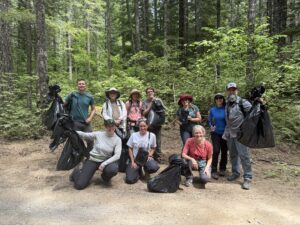
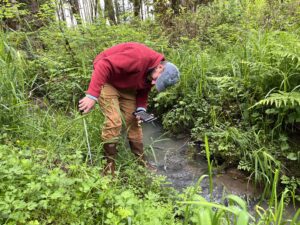
By detecting and treating infestations early, we aim to reduce long-term impacts and help protect these vulnerable ecosystems. We can sometimes treat these areas on the spot through hand-pulling; other times we share our findings with the Forest Service and the county weed treatment teams for more comprehensive treatment and, hopefully, continual monitoring. While this effort won’t stop all new infestations, it’s a meaningful step we can take, and one that we’re pursuing through volunteer trips that bring community members directly into these forests to assist with invasive plant surveys and control.

We continue to highlight these risks in formal comments on timber sales and in our conversations with Forest Service planners. More recently, we’ve launched an additional new effort to monitor recently logged forests for early signs of invasive plant establishment.

By detecting and treating infestations early, we aim to reduce long-term impacts and help protect these vulnerable ecosystems. We can sometimes treat these areas on the spot through hand-pulling; other times we share our findings with the Forest Service and the county weed treatment teams for more comprehensive treatment and, hopefully, continual monitoring. While this effort won’t stop all new infestations, it’s a meaningful step we can take, and one that we’re pursuing through volunteer trips that bring community members directly into these forests to assist with invasive plant surveys and control.
Timber harvest and wildfires

Continue reading

A WIN-WIN FOR SALMON AND SW WASHINGTON COMMUNITIES

Working with the Department of Health, drinking water providers at Lewis County Public Works, and Lichen Land & Water, Cascade Forest Conservancy has been working for the last year to assess restoration potential in the Salmon Creek watershed. This is the Salmon Creek that flows into the Cowlitz River and serves as a drinking water source for the cities of Vader and Castle Rock, WA. Most of the project area is on properties owned by Weyerhaeuser.


Our hope is to identify areas throughout the watershed where instream restoration, and low-tech process-based restoration in particular, can improve both drinking water and habitat quality. These riparian corridors are important for anadromous salmon, resident fish species, amphibians, and a multitude of species that depend on healthy and biodiverse river corridors.


Through restoration, our aim is to improve the quality of drinking water by addressing the current high levels of sedimentation in the water and to attenuate flows, thereby reducing costs for the municipalities and reducing the amount of chemicals and filters needed to bring high-quality drinking water to the residents of Castle Rock and Vader.


EXCITING DEVELOPMENTS FROM THE INSTREAM WOODBANK

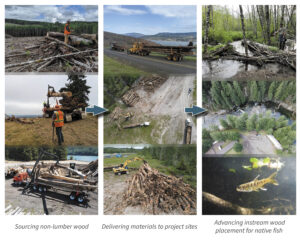
We are excited to share some recent developments from the Instream Wood Bank. Since 2020, the Instream Wood Bank has supported aquatic restoration and salmon habitat improvement projects in the region by sourcing non-lumber wood and supplying it to partners at discounted rates. Our partners use these logs to return streams to conditions that existed before streamside logging and development resulting in oversimplified waterways lacking instream wood and pools for habitat.


Our latest endeavors have taken us from the pine-dominated landscapes of Husum, WA, westward to the forests of Merrill Lake and the industrial timberlands around Toutle, WA.

We recently completed a movement of wood near Husum, WA for the Yakama Nation and Underwood Conservation District. Our partners from Mount Adams Resource Stewards identified the available wood for us and initiated the effort. We sourced around 200 logs with rootwads attached—ideal for instream placement. These logs will be used to build fish habitat on White Creek, which flows into Klickitat River, and Rattlesnake Creek, which flows into White Salmon River. We hired a local hauling team to pick up the wood and deliver it to our partners. 


Wood being delivered for partners at Underwood Conservation District.


We have also procured approximately 150 cottonwoods and spruce for our long-term partners at the Lower Columbia Fish Enhancement Group. Rather than heading to the burn pile or pulp mill, these trees are enhancing habitat in the South Fork Toutle River. Remarkably, these logs hail from Weyerhaeuser timberlands, signifying an uncommon collaboration forged through numerous deliberations between our organization and one of the nation’s most prominent timber companies. We envision a future where such synergistic partnerships thrive, given the diverse array of prospects for utilizing this non-lumber wood in habitat restoration endeavors.

In addition to these two large wood movements, the Wood Bank was recently featured in a Washington Department of Natural Resources newsletter and another from Washington State University, which is distributed to small forest landowners in the state. This has led to a number of new connections, including recent conversations with private landowners near Merrill Lake who have several large truckloads of hemlocks that had fallen or were felled as hazard trees and were going to be sold as pulp. With the pulp market low at the moment, these landowners reached out to the Wood Bank and are finding a new home for their trees. We are currently ironing out logistics to carry out the haul later this month.


Sourcing non-lumber wood from Weyerhaeuser timberlands.


We are immensely pleased with how the Wood Bank has been going. This is exactly the niche it was intended to fill. We are identifying sources of non-lumber wood (or having landowners reach out to us as word of the Wood Bank has gotten around), and we are sending these logs to aquatic restoration sites across the region. This helps our partners carry out their important instream work for less money and with fewer trees being cut for those purposes.

GATHERING DATA TO PROTECT CLEAR CREEK

Last month, Cascade Forest Conservancy staff and volunteers ventured out to the forests and meadows between the Dark Divide and Spencer Ridge roadless areas to capture on-the-ground information for a potential future protected area. This part of the forest, which we refer to as the Clear Creek area, has been part of internal discussions at CFC for the last several months as we have been refining conservation recommendations that will be included in our soon-to-be-published second-edition Climate Resilience Guidebook. 

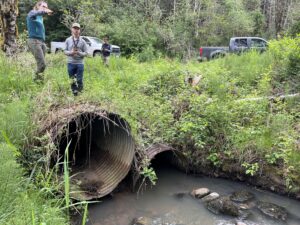
While out in the field, participants ground-truthed old-growth maps to ensure we are protecting these rare habitats and surveyed roads that may be candidates for decommissioning. In addition to finding swaths of large Douglas-firs on the hillsides and groves of giants standing next to wet meadows, we toured miles of the forest road system to collect information about vegetative regrowth, culvert function, and general observations of use and disrepair.


Our Guidebook will examine the impacts that climate change is expected to have on southwest Washington’s ecosystems and outline recommendations to build resilience and increase carbon storage. We identified the Clear Creek area as a priority area for protection for a few reasons.


A LARGE ROADLESS REFUGE


First, because of its location between two roadless areas, protecting this area represents an opportunity to create a large, connected roadless area that can serve as high-quality, connected habitat for wildlife. It is already an area with relatively few roads, and most that do exist here are maintenance level 1 roads, meaning they are likely remnant roads from the timber heyday and not open for public use. These remain in the system in case they are needed for future timber harvests. There are also a handful of maintenance level 2 roads. These are backcountry roads, which in some cases are well used and appreciated and in other cases are under-maintained and already starting on a process of natural recovery where trees and other vegetation are reclaiming their foothold. These roads can be good candidates for closure and if old culverts remain along the route, they are good target roads for more thorough decommissioning where natural water flows are re-established and the area is set back on a trajectory toward wild-ness.


Over the next few years, we plan to work with volunteers to better understand which roads are suitable candidates for closure or decommissioning and to work with agency staff to advance these efforts. As a large roadless area with beautiful meadows and ancient old-growth forests, we will also explore opportunities to increase backcountry recreation opportunities like hiking and backpacking. There are many defunct roads which could be good candidates for a road-to-trail conversion.


A DENSITY OF OLD-GROWTH


Another reason this area became a top contender for protection is the presence of large tracts of intact old-growth and mature forests that exist here. Old-growth forests are a relatively rare ecosystem in the region, so we work diligently to ensure that all old-growth is retained and mature forests are protected to serve as our future old-growth.


In the coming months, we will be publishing the Climate Guidebook with pinpointed strategies for improving the health and resilience of the landscapes of the southern Washington Cascades. Stay tuned!