Beaver Reintroduction Project Update

July 31, 2020

In 2018, Cascade Forest Conservancy partnered with Cowlitz Indian Tribe to reintroduce beavers to the Gifford Pinchot National Forest for the first time since the 1930s.

It’s difficult to overstate the importance of these animals to the health of the forest. In his award-winning book, Eager: The Surprising, Secret Life of Beavers and Why They Matter, Ben Goldfarb describes the fur trade that eradicated beaver populations as an ecological and social disaster on par with the destruction of the bison herds of the Great Plains.

Beavers are a keystone species–dam-building, wetland restoring, water-storing, habitat engineers. The weight of their ponds push water deep into the ground, refilling aquifers and allowing water to be in the system even during dry summers. The slack waters and ponds beavers create help filter pollutants out of water systems, dissipate floods, disrupt the spread of fires, and create habitat that greatly benefits other species. In some parts of the West, wetlands cover 2% of the total land area but contain 80% of an ecosystem’s biodiversity. As the effects of climate change accelerate, the benefits beavers bring to the landscape are more important than ever.

So far, this project has been a success, and it’s still going strong!


We’re expanding the project and releasing even more animals this year. Here is the latest.

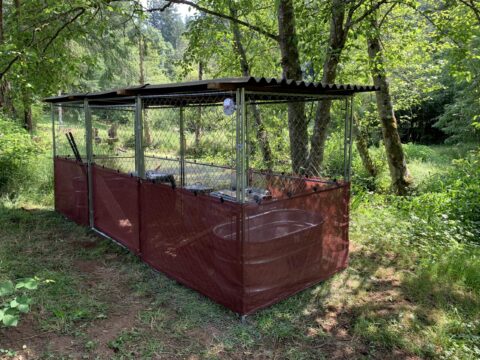
Our Program Director, Shiloh Halsey, and Science and Stewardship Manager, Amanda Keasberry are now permitted by the Washington Department of Fish and Wildlife to house and relocate beavers in multiple SW Washington counties. In July, we completed building our new beaver housing facility on land belonging to a generous supporter. Trapped beavers must be kept in housing facilities where we monitor their health and collect data before release.

We’re thrilled to be expanding the capacity of this program. We plan to release 3-4 beaver families this fall–families of beavers are made of between two to six animals.

This year, the project will benefit from an additional partnership. Researchers from Washington State University Vancouver are working on a new way to track beavers and understand their impacts, one that uses environmental DNA taken from water samples. The researchers will be working with the beavers who pass through our new facility and tracking them post-release. The new technique they are developing could be key to monitoring wild and reintroduced beaver populations without having to physically track down individual animals.

SPIRIT LAKE PROJECT UPDATE

June 26, 2020


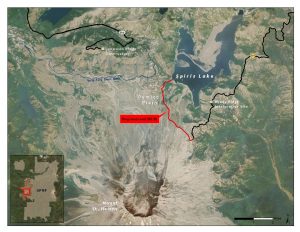
Some places are too special, too beautiful, and too important to risk losing. One of those is the Pumice Plain, a 6-mile long area between the crater of Mount St. Helens and Spirit Lake. This landscape is unique, pristine, and has transformed our understanding of aspects of ecology. Now, a proposed road through the heart of this place is putting it at risk of being lost.


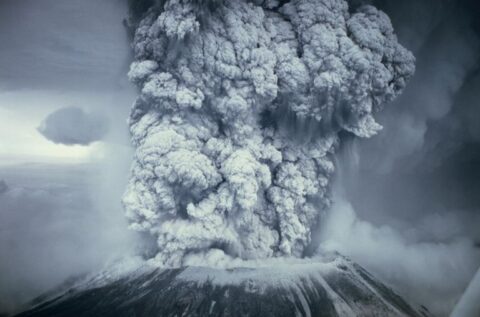
The Pumice Plain is, in geologic time, a brand-new area. When Mount St. Helens erupted forty years ago on May 18, 1980, it erupted sideways. That day, the area north of the mountain was buried under hundreds of feet of superheated ash and pumice–nothing survived.

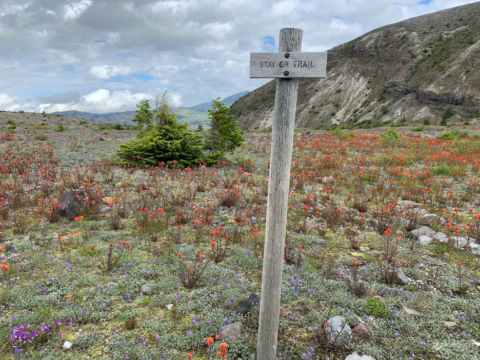
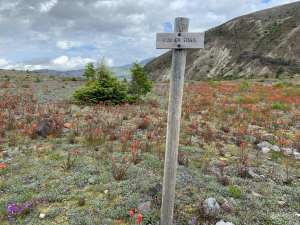
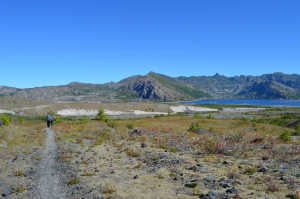
But more quickly than we thought possible, life has come back. The Pumice Plain is still a rugged, harsh, windblown landscape–but now rich with insects, flowers, plants, and animals, each attesting to the stubborn resilience of life. The area’s protected status has meant that hikers have had a unique opportunity to see a Cascadian volcano’s power and the return of life up close. It has also allowed scientists and researchers to make some surprising discoveries that wouldn’t have been possible anywhere else on Earth.


Despite the area’s scientific value and protected status as a National Monument and a Class I Research Area, the Forest Service plans to construct a road here for easier access to infrastructure (a drainage gate at nearby Spirit Lake). The drainage gate helps prevent a breach of the lake, which could pose serious danger to downstream communities. But this road is not the only (or even fastest or best) way to keep people safe. The road would close the world-famous Truman Trail, damage newly forming streams and watersheds, introduce invasive species, and disrupt, or end ongoing scientific studies. We could lose this place forever.

There is enough we know now to stand against this project. Yet the real extent of the potential impacts are not fully understood. The Forest Service avoided their obligation under the National Environmental Policy Act (NEPA) to provide an Environmental Impact Statement (EIS), a detailed study which is typically required for a project like this. They did so by announcing a Finding of No Significant Impact, meaning the Forest Service has come to the conclusion that the road will not have a significant impact (positive or negative) on the people, plants, and animals who inhabit this place. We know that isn’t true. There will be impacts, and they will be permanent. We need to know what they will be.


There are other problems with the plan too, like the addition of core sample drilling along the lake and many more issues you can read about in detail in our objection, submitted to the Forest Service in May, which you can read here. It is critical that we stop this planned project and find a better way to protect people living in downstream communities. We are asking the agency to take a step back. Cascade Forest Conservancy is ready and willing to advocate for the funding the agency needs to complete a full EIS, and to work cooperatively to explore alternative solutions that protect Washingtonians while preserving this irreplaceable place.

The official objection period for this project has passed, but it’s not too late to raise more public awareness for the Pumice Plain. Share this article, or plan a visit to the Pumice Plain to see how special this place is for yourself. Cascade Forest Conservancy and many other organizations and concerned individuals submitted objections to the Forest Service. We will attend an objection resolution meeting with the agency on July 8th. After, we will know if the Forest Service will decide to work with us to find a better solution, or if the agency will push forward with the plan as is. Either way, we will continue fighting to preserve this landscape and keep our friends and supporters informed along the way.

Environmentalists must speak up about racism

June 3rd, 2020

Here at the Cascade Forest Conservancy, we work every day to protect the places and people of southern Washington’s Cascades. Some may wonder why an environmental organization should take a stand on an issue some would consider beyond the scope of our mission. We don’t see it that way. Our efforts are regional, but our vision, one in which human communities exist in harmony and peace with the thriving natural world, is global. Racism and racist violence are antithetical to that goal. Environmental wellbeing is not possible apart from social and racial justice.

The protests that have spread across our nation are not solely about the murder of George Floyd by Minneapolis Police officers. We are still mourning the death of Emmett Till. Of Tamir Rice. Of Sandra Bland. Of Trevon Martin, and countless other precious lives. We are still mourning the historical looting and land theft of the indigenous peoples of our region, and the continuing discrimination and injustice these communities face today.

A majority of our staff benefit from white privilege, as do many other leaders within the environmentalist movement. Historically, conservationists have not been vocal leaders in the long fight for social and racial justice in this country. We can no longer bear to remain in the silence our privilege affords.

At CFC, we are committed to listening, and speaking up when we see injustice–whether that be environmental policies that endanger the health and safety of marginalized communities, unequal opportunities to safely enjoy the benefits wild places provide, unjust laws, or police brutality.

We ask that you join us. Listen to and amplify the voices of Black, Brown, Indigenous, and POC perspectives. Research intersectional environmentalism. Read about the history of Vanport. Educate yourself about the history of indigenous peoples in our region (Vine Deloria Jr.’s Indians of the Pacific Northwest is an excellent place to start) and continue to fight for a world that is sustainable, whole, and where black lives matter.

Hiking Safely in the Gifford Pinchot National Forest

May 22 2020

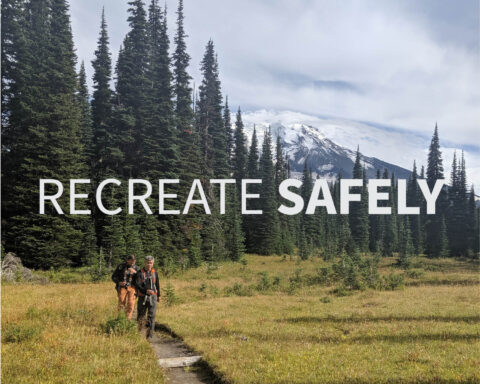
If you’re anything like us, you can’t wait to get back out on the trail this summer. It was recently announced that after COVID-19 closures, most of the day-use trails and recreation areas in the Gifford Pinchot National Forest have reopened. As glad as that news makes us, the situation is far from back to normal. Here’s what you need to know before hiking in the Gifford Pinchot National Forest during the pandemic:

Check ahead of time to confirm that the area you plan to visit is open. You can find information on current trail openings and closures at the Gifford Pinchot National Forest’s website here. 

Site facilities may still be closed. Just because the trailhead is open, does not necessarily mean the site’s facilities are. Vault bathrooms may be open, but the Forest Service will not be maintaining them as usual because employees don’t currently have the PPE to do so safely. There is no guarantee that open facilities are COVID free. Take precautions for your own safety and the safety of others. Plan (and pack) accordingly.

Avoid crowded areas. If you get to a trailhead and the parking lot is full, don’t hike there. Period. The trail will be too crowded to safely practice social distancing. Plus, if you park on the side of the road, you could be towed, and who wants to end a day in the woods trying to hitch a ride to an impound lot? Not us. Probably not you either. Have a plan B (maybe even a plan C) before you head out.

DO NOT visit stores in rural communities. Can’t stress this one enough: unless you’re a local resident, don’t stop into stores in rural communities. Plan ahead and bring everything you’ll need with you. Don’t risk exposing people in rural communities to the virus because you didn’t bring enough water or snacks.

Campgrounds are still closed, but dispersed camping is allowed. Campgrounds currently remain closed and the GPNF is working to open them with safety as the number one priority.  If you choose to disperse camp, please take all of your trash home and dispose of human waste properly.

These are strange times, so be safe out there. If a hiker or other recreational user gets into trouble, response times will likely be longer since local emergency responders (many of whom are volunteers) are also under the Executive Order unless necessary or exempted. Emergency responders are also focusing on keeping their local communities safe. So remember, always pack the 10 essentials. Bring more food and water than you think you need. Bring basic first aid, supportive footwear, and rain-gear, no matter what the weather forecast says. Tell someone where you are going and when you will be back.

We’ll see you (from a safe distance) on the trail!

What’s at stake in the Mount St. Helens national monument 40 years after the eruption?

by Bryn Harding | Communication Manager

May 18 2020

I was born a few years after the eruption of Mount St. Helens. The two five-gallon buckets of fine gray ash stored in our garage were curiosities I mostly ignored as I explored the seemingly ageless mountains, streams, and forests of the Pacific Northwest. They were certainly interesting–not only because of the stories associated with them, but also because their weight seemed alien, as if the contents of the buckets was at once too light and too heavy. In my mind, the Pacific Northwest had always been a place defined by peace and stillness. But as that ash attested to, the Pacific Northwest is in fact a place of incredible power and violence, of death and rebirth, destruction and transformation.

The Pacific Northwest is a land of volcanoes. Major eruptions and corresponding cycles of destruction and regrowth are a part of the fabric of this place. Yet, as common as these events may be geologically, in the span of any single human lifetime they are rare, which is why we are so lucky to have the chance to observe, record, and learn from the areas protected from human interference within the Mount St. Helens national monument, the most active volcano in the Cascades.

At places near the blast zone, like Spirit Lake and the area now referred to as the Pumice Plain, the destruction following the famous May 18th eruption seemed permanent. However, life has already begun to come back. “I’ve been lucky in my lifetime to watch Spirit Lake transform from a cold, clear body of water to a coffee-colored, lukewarm basin of pathogens and then back to a cold, clear lake teeming with new life.” wrote Christine Colasurdo, author of Return to Spirit Lake: Life and landscape at Mount St. Helens, “Spirit Lake is a unique place of mystery and beauty that deserves our awe and respect.”

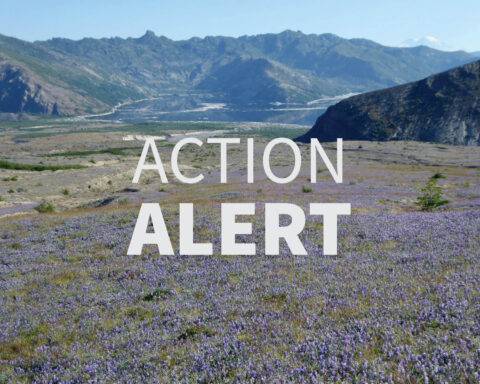
The return of life to the Pumice Plain has been similarly enlightening. Within just a few years of the eradication of all plants and animals, some species started to return, and prairie lupine began to flower. Now the area, featuring trails much enjoyed by curious hikers from around the world, teems with birds and insects, as grasses, wildflowers and young willows sway in the breeze. “The Pumice Plain, once baked clean of life by the 1980 eruption,” wrote Colasurdo, “is now one of the prime treasures of the Mount St. Helens National Volcanic Monument. It is where research done by scientists has helped rewrite biology textbooks, and where hikers can experience the awesome power of Mount St. Helens’ blast zone.”

Spirit Lake and the Pumice Plain have provided us with insights into how habitats, ecosystems and watersheds form, insights that are changing how we think about managing and protecting the world around us. Right now, there are more than 30 studies currently underway in this natural laboratory; each taking advantage of the protected and undisturbed areas within the National Monument to gain insights not possible anywhere else.

Yet today, the Pumice Plain is facing a new threat. This time the danger comes in the form of a proposed road to be constructed through the heart of this unique, beautiful and irreplaceable area. There is a real need for the Forest Service to access infrastructure near Spirit Lake, but we don’t think this road is the right solution to that problem. The road risks the unique beauty and insights this site offers to hikers and the ability of researchers to complete their work and add to our knowledge. CFC will be sharing ways you can help us in our efforts to protect this place in the coming weeks.

For now, we encourage you to learn more about Spirit Lake and the Pumice Plain. Reading Christine Colasurdo’s helpful and informative book is a great place to start. Colasurdo’s book is available by emailing her through her website (www.christinecolasurdo.com.) It’s also available online through Annie Bloom’s Books and Broadway Books.

If you would like to learn more about some of the scientists working in this area, we encourage you to start with the articles here and here.

ACTION ALERT: Object to the proposed project at Spirit Lake

April 30, 2020

We need your help. On April 7, the US Forest Service released a draft decision and Environmental Assessment (EA) for the proposed action at Spirit Lake. The Forest Service plans to move forward with the proposal to construct a road straight through the Pumice Plain. Those of you who commented on the original proposal now have an opportunity to object to the draft decision, no later than May 22, 2020.

[Note: The Forest Service will only accept objections from individuals who previously submitted public comments, and objections must relate to the specific issue[s] discussed in your original comments. Didn’t comment but still want to help protect the Pumice Plains? Help CFC get the word out by sharing the articles linked below on your social media accounts. CFC commented on the original proposal, will be submitting detailed objections to the draft decision, while we continue working to raise public awareness around this issue. If you’re in a position to do so, consider making a donation to CFC to support our conservation work.]

The US Forest Service has released its draft decisions and EA for activities to replace the Spirit Lake intake gate system and to drill into the debris field from the 1980 eruption of Mount St. Helens. To accomplish this, The Forest Service plans to build a 3.5-mile, 16-foot wide road across the Pumice Plain within the Mount St. Helens National Monument, replacing the Truman Trail (https://www.wta.org/go-hiking/hikes/truman-trail-pumice-plain)
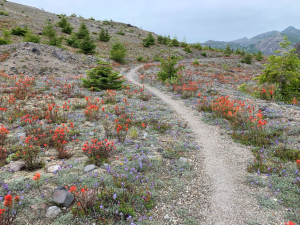
The Pumice Plain is like nowhere else on Earth. Since the destruction brought by the 1980 eruption, the area has been protected, researched, and allowed to return without interference. As a result, the Pumice Plain is now a wild and beautiful natural laboratory that is reshaping our understanding of ecosystem development.

The proposed road would severely impact the Pumice Plain by:

• disturbing wildlife including mountain goats, fish, deer, and elk.  

• negatively impact streams, watersheds, and wetlands, 

• disrupting recreation and hunting, 

• opening a potential door for invasive species,

• impacting, and possibly destroying  25 research plots, and cutting across most of the transects scientists and researchers have been using to record the recovery of the area.

The proposed project addresses legitimate concerns. There is a need to modify and repair the intake gate for the Spirit Lake Tunnel, and to provide access for tunnel maintenance to protect downstream communities. But the timeline expressed in the draft decision does not accurately reflect the situation. It would take an abnormal series of climatic events followed by months of inaction to result in a breach. In the unlikely event of infrastructure failure around Spirit Lake, there would still be “substantial response time to prevent catastrophic breaching and protection of the downstream communities.”*

We believe the agency is using the ruse of an emergency as the pretense for forcing action without a fair public participation process or adequate analysis in the form of an Environmental Impact Statement. Additionally, we believe that the need for the geotechnical drilling project is premature, and by combining these projects the agency is dismissing reasonable alternatives that could minimize impacts on the environment, wildlife, and research, while still protecting downstream communities.

CFC formed a coalition and voiced our concerns when the project was proposed. The recently released draft decision does not adequately address our concerns with this project. We are submitting a formal objection to the agency’s decision and will continue to do all that we can to advocate for a plan that both protects communities and this beautiful, important, and unique place. 

*Grant, et al., GEOLOGIC, GEOMORPHIC AND HYDROLOGIC CONTEXT OF THE SPIRIT LAKE OUTLET (2017).


Action:

Objections to the Spirit Lake Intake Gate Replacement and Geotechnical Drilling Project or to the forest plan amendment will only be accepted from those who have previously submitted timely comments regarding these planning efforts during any designated opportunity for public comment in accordance with the project objection requirements in section 218.5(a). Issues raised in objections must be based on previously submitted timely, specific written comments regarding the proposed project unless based on new information arising after the designated comment opportunities.

Please reach out to us at info@cascadeforest.org with questions about submitting objections. 

Objections can be submitted electronically here:

https://cara.ecosystem-management.org/Public//CommentInput?Project=57259

Objections may also be mailed to:

 Regional Forester (Reviewing Officer)

Pacific Northwest Regional Office

Attn: 1507 Objections

P.O. Box 3623


Articles to share:

The Daily Chronicle Researchers, Conservationists Raise Alarm About Proposed Road Through Mount St. Helens Pumice Plain* January 24, 2019

The Daily News Mount St. Helens ecological research could help conserve, restore nature April 8, 2020

The Columbian ‘Floating habitat’ could be key for Spirit Lake fish April 5, 2020

*this article references the withdrawn 2019 Spirit Lake project proposal, which was similar to the current 2020 proposal.


Photos by Carri LeRoy
Spirit of '70: The Origins of Earth Day

By Michal Orczyk  |  Development Director

April 22, 2020

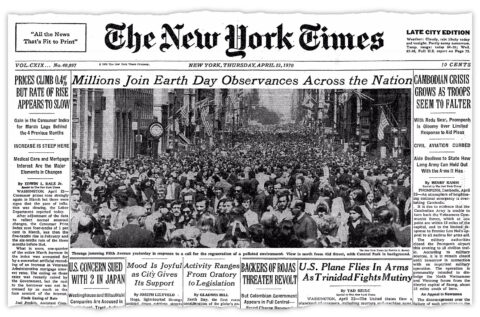
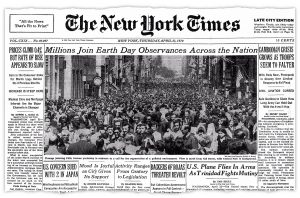
Today is Earth Day, and it’s a special one: today we’re celebrating the 50th anniversary of this historic moment in American history, which has now become a global phenomenon. Many people know about Earth Day, but those who weren’t around in 1970 might not know its origins. It is an amazing story that shows how grassroots activism, as well as courageous political leaders (sorely lacking in our day) can make sweeping changes in our world.

In American government and society, some initial discourse about human impacts on the environment began in the 19th and early 20th centuries. Writers like John Muir popularized a romantic vision of nature and wilderness, and how human values were sometimes in conflict with nature. National parks like Yellowstone and Yosemite were established in 1872 and 1890 respectively, and the idea of wilderness as a valuable part of the American landscape began to be appreciated (though indigenous people understood this long before). However, it wasn’t until the middle of the 20th century that scientists, naturalists and activists started to raise considerable alarm over the impacts of human industry on wildlife, landscapes, and our own health. Concepts like air and water pollution, biodiversity, and climate change began to take hold. One watershed moment was the publication of Rachel Carson’s Silent Spring, which sold over 500,000 copies in 24 countries.

In the late 1960s Wisconsin Senator Gaylord Nelson was inspired by the student environmental movement, and announced the idea for a teach-in on college campuses to the national media. He also persuaded Pete McCloskey, a conservation-minded Republican congressman, to serve as his co-chair. They chose April 22, a weekday falling between Spring Break and final exams, to maximize the greatest student participation. 

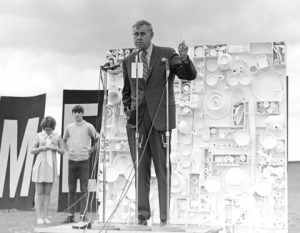
Dennis Hayes, a young activist and the organizer of this teach-in, realized the potential for this event to gain traction, and turned it into a national campaign that quickly drew massive media attention. Soon there were events planned in towns and universities across the United States. Nearly 20 million Americans took part! A high school senior in Portland convinced Oregon Governor, Tom McCall, to deliver a speech to an audience at his school, Fremont Junior High School (today Parkrose Middle School).

(Oregon Governor Tom McCall speaking at an Earth Day event in 1970. Source: Oregon Historical Society)

Earth Day 1970 achieved a rare political alignment, enlisting support from Republicans and Democrats, rich and poor, urban dwellers and farmers, business and labor leaders. By the end of 1970, the first Earth Day led to the creation of the United States Environmental Protection Agency and the passage of other first of their kind environmental laws, including the National Environmental Education Act,  the Occupational Safety and Health Act, and the Clean Air Act.  Two years later Congress passed the Clean Water Act.  A year after that, Congress passed the Endangered Species Act and soon after, the Federal Insecticide, Fungicide, and Rodenticide Act. These laws have protected millions of men, women and children from disease and death and have protected hundreds of species from extinction. (Source: https://www.earthday.org/history/)

CFC had big plans for Earth Day 2020, and due to COVID-19 we have to change some of those. However, we’d like to thank the organizers of Earth Day Oregon for bringing together hundreds of Oregon businesses and nonprofits to share a message – we must protect our home, our planet, from our own reckless behavior. Check out https://earthdayor.org/ to learn more about this wonderful state-wide campaign. Special thanks to our Earth Day Oregon 2020 business partners:

Chinook Book

Aesthete Tea

Jam on Hawthorne

Falling Sky Brewing

Oregon Data

Citizen Science in your Backyard

By Amanda Keasberry  |  Science and Stewardship Manager

April 17, 2020


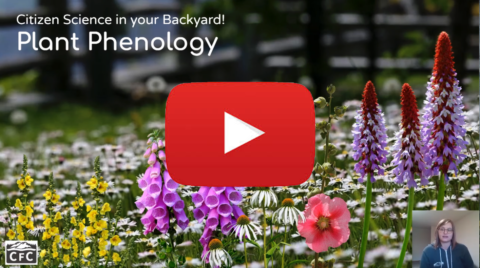
April is Citizen Science Month and you can still be involved! Our Science and Stewardship Manager, Amanda, delivers a message about the importance of understanding the life-cycle events of plants (phenology) and how you can help climate science researchers collect data by observing plants in your backyard or neighborhood.

April is Citizen Science Month & You can still be involved!

By Amanda Keasberry  |  Science and Stewardship Manager

April 16, 2020

Many of our important stewardship and restoration projects rely on the generosity of volunteer citizen scientists who join us in the forests of Washington’s south Cascades. April is Citizen Science Month, and I recently began to wonder more about the origins of citizen science, and why it’s become so popular today. So here is a quick dive into the fascinating history of citizen science!

“In citizen science, the public participates voluntarily in the scientific process, addressing real-world problems in ways that may include formulating research questions, conducting scientific experiments, collecting and analyzing data, interpreting results, making new discoveries, developing technologies and applications, and solving complex problems” (citizenscience.gov). 

The first mention of ‘citizen scientist’ appeared in a 1979 New Scientist article by James Oberg. Oberg wrote about his skepticism that ufology, the study of unidentified flying objects, could be called science and argued that those who studied this “science” were “crackpots and cranks,” whom he later referred to as “citizen scientists.” The first mention of the term was drenched in sarcasm, but nonetheless, those were people of the general public making new discoveries (people just might not agree on what those discoveries actually were…). The term ‘citizen scientist’ was not seen again in writing until 1989 when it was officially used by the Audubon Society to describe a group of 225 volunteers who helped collect rain samples to assist with an acid-rain awareness campaign. 

But long before the term ‘citizen science’ was ever used, there were many amateur and non-professional scientists who volunteered their time to further scientific understanding and exploration. Some of these amateurs are now considered some of the most renowned scientists of all time, like René Descartes, Charles Darwin, and Issac Newton. All of them began as independent, amateur scientists who were initially headed down a different career path. But their intrigue for science led them to discoveries of fundamental scientific concepts and theories which continue to shape our understanding of our world to this day. By the 20th century, science was mostly taken over by professional scientists and researchers who obtained funding through universities and governmental agencies. It wasn’t until the 1970s that the bureaucracy of science research was being brought into question, and the revival of the amateur scientist was being advocated for.

By the 1990s, the use of ‘citizen science’ began to take off and there was an increase in the number of citizen projects, the variety of projects, and the size and scope of projects. Volunteers were being used across all fields and disciplines–making important contributions everywhere from astronomy to oceanography and everything in between. Today the number of citizen science participants have grown even more thanks to technological advancements. Advances like the internet and the creation of mobile smartphones have not only made information easier to obtain, but have created new ways for researchers to engage with large groups of people. For scientists who rely on data collected from the field, smartphones and their connectivity to the internet and their internal global positioning systems have greatly increased the ease of collecting data anywhere in the world. Volunteers are making huge contributions to our knowledge, whether gathering data from their own backyards or in the most remote places of the forest. 

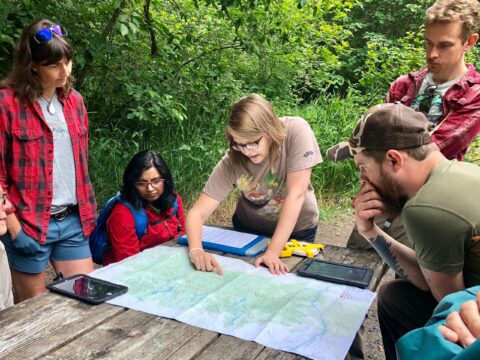
CFC has greatly benefited from being able to use smartphones and tablets when out in the field to collect geospatially-referenced data that we can easily share with our partners and the community. Using smartphones or tablets also allows for a uniform way to collect data. We tend toward simplicity in survey design and clarity in the data collection process to ensure quality and consistent data is collected. The quality of data collected by citizen scientists often raises concern among researchers. Some researchers discredit citizen science work, while others believe volunteers can collect comparable data to that of professional scientists. CFC believes there is a huge benefit to public involvement in science and restoration projects and that, in addition, it helps build support from the community for important restoration and conservation work. Citizen science has been an integral part of many of our projects like huckleberry monitoring, beaver habitat site assessments, and the wildlife camera surveys. 

We could not gather as much data without the help of citizen scientists, and I know this is the case for other organizations, agencies, and researchers.

Most citizen science projects, including ours, are put on hold right now. But there are actually plenty of citizen science opportunities that you can participate in from the comfort of your home. I will be posting a tutorial for a fun project related to climate change that you can participate in right in your backyard or neighborhood. By participating in this project, you will provide researchers with a more robust dataset which will help them to answer some of the unknowns about climate change. Stay tuned for the video on Friday!

Our Quarantine Reading List (part 2 )

Part two of our quarantine reading list features submissions from Suzanne Whitney and Lucy Brookham. We hope these great reads inspire, intrigue and entertain you as we work together to flatten the curve. Stay safe everyone, we’re in this together.

– The CFC Team


SUZANNE WHITNEY  Science and Restoration Manager


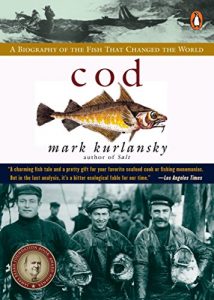
Cod: A Biography of the Fish that Changed the World
by Mark Kurlansky 

This is a fascinating and accessible book that explores the intersections among ecology, human history, food, and conservation. The global impact of this one species is amazing! If it leaves you wanting more, follow up with Four Fish: The Future of the Last Wild Food by Paul Greenberg.


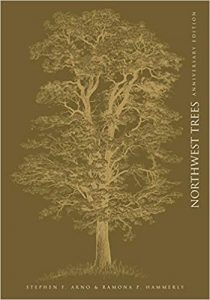
Northwest Trees: Identifying and Understanding the Region’s Native Trees

By Ramona Hammerly and Stephen Arno

While sheltering in place, I’ve been digging into a couple of books to beef up my knowledge of Pacific Northwest species. In particular, I’m enjoying Northwest Trees: Identifying and Understanding the Region’s Native Trees by Stephen Arno. This book includes beautiful illustrations and spends several pages providing deeper information on each species. It’s a great compliment to a comprehensive field guide.


All That the Rain Promises and More…

by David Arora

Want to think about mushrooms instead? All that the Rains Promise and More… is a fun place to start.


Prodigal Summer

by Barbara Kingsolver

A sweet novel that weaves conservation issues (pesticide use, importance of predators, conservation genetics) into a story that connects several members of a small community in southern Appalachia. If you don’t do fiction, Kingsolver also writes lovely essays that combine human experience and her passion for natural history; High Tide in Tucson is a nice collection.


Creation: An Appeal to Save Life on Earth

by E.O. Wilson

If you enjoyed Shiloh’s recommendation of A Sand County Almanac, you could try The Creation: An Appeal to Save Life on Earth by E.O Wilson. This book is a plea from a southern gentleman and one of the greatest minds in ecology in which he makes a case for why conservation should be a priority for religious leaders (and everyone).


Desert Solitare

By Edward Abbey

If you prefer a more radical take, I also love Desert Solitaire by Edward Abbey. Leopold, Wilson and Abbey are very different authors with different motivations, but they all make the case for conservation and preservation in personal ways based on their own life experiences.


LUCY BROOKHAM  Policy Manager


The Book of Fire

by William H. Cottrell

A short and highly illustrated book for all ages – introducing non-scientists to the anatomy of wildfire. Beginning at the molecular level, the book illustrates and describes the process of flame-progression, from how a twig catches fire to how an entire forest burns.
 

Sea and Smoke: Flavors from the Untamed Pacific Northwest
by Blaine Wetzel and Joe Ray

An ambitious cookbook celebrating the cuisine of hyperlocalism inspired by the rugged coastal location of Lummi Island.


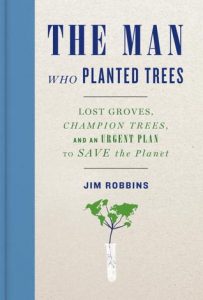
The Man Who Planted Trees

by Richard Powers

A poetic and inspiring story of one man’s quest to clone the world’s champion trees in an effort to save the planet’s essential ecosystems. A light and easy read that incorporates forest ecology and storytelling.